Registering an OAuth application

Register an application on the Capsule Developer Portal to obtain the Client ID and Client Secret that StackOne uses to connect accounts.

1

Sign in to the Capsule Developer Portal

Sign in to the Capsule Developer Portal.

  • The portal signs you in with GitHub, not with your Capsule account — on the Sign in page, click Login using Github.
  • The page states: To get started or to view your existing apps, please login with your Github username and password.
  • If you are already signed in, you go straight to Your Applications.
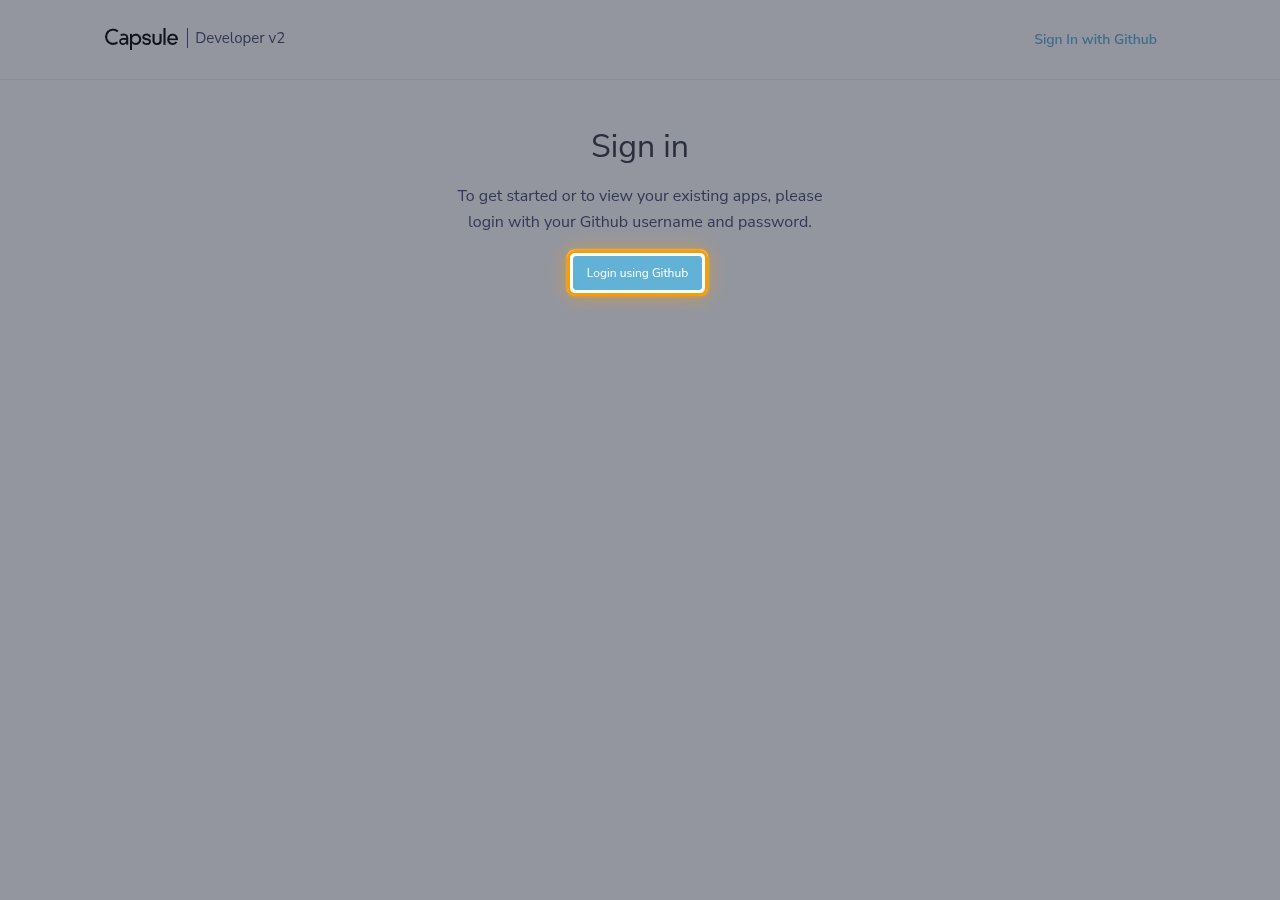
The Capsule Developer Portal sign in page with the Login using Github button highlighted
2

Open the new application form

On the Your Applications page, click New Application.
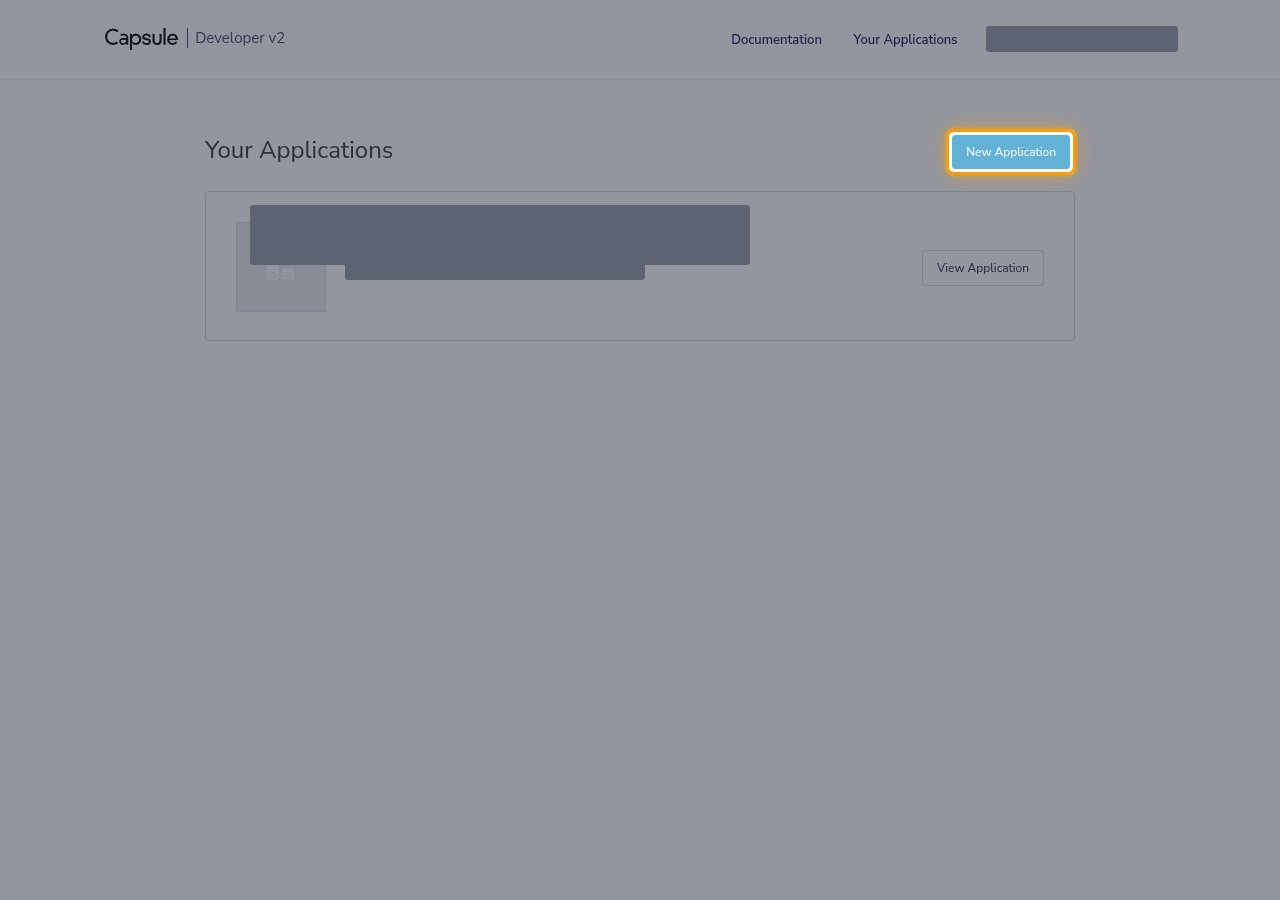
The Your Applications page with the New Application button highlighted
3

Fill in the application details

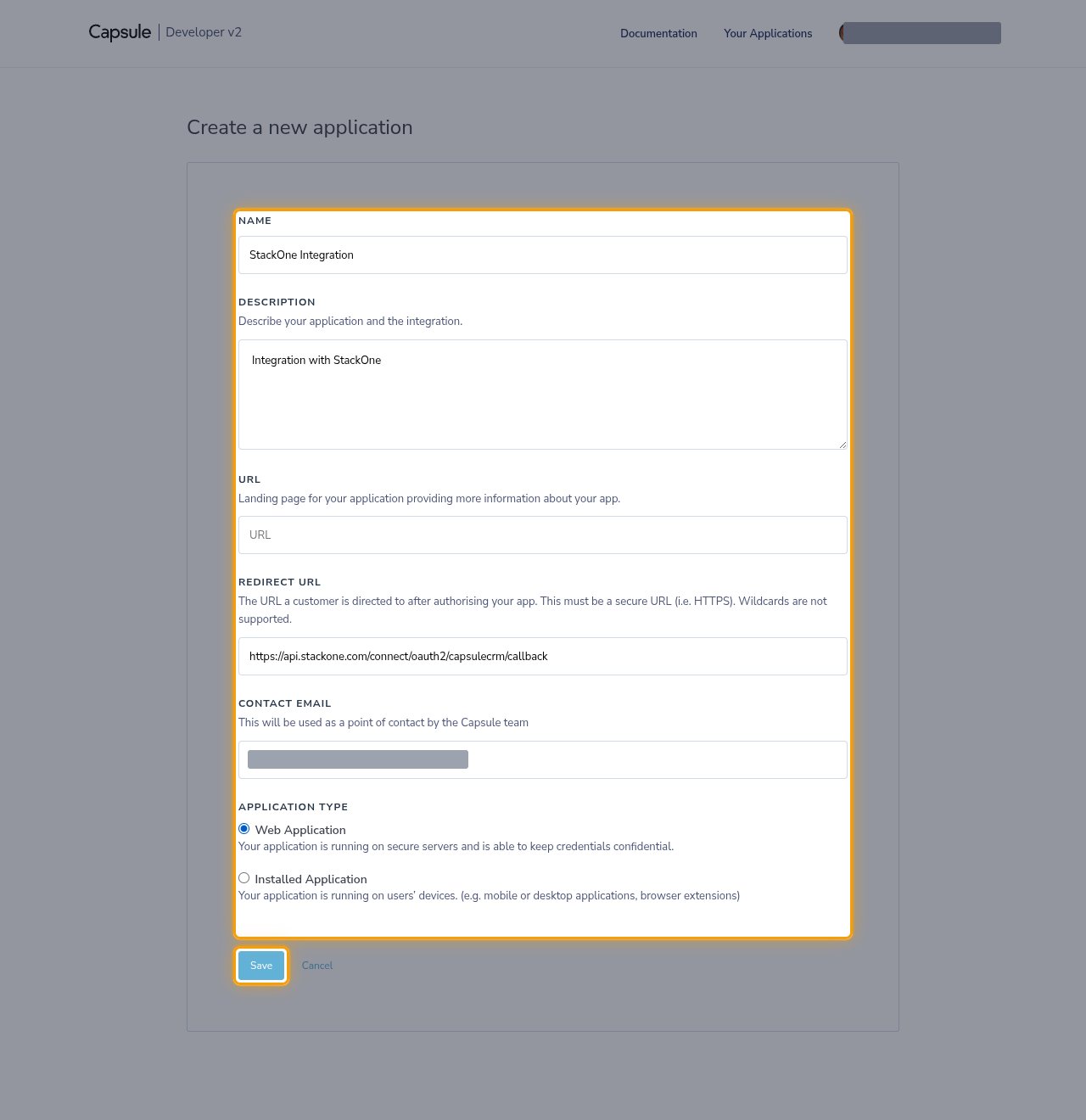
Complete the Create a new application form.

  • Name: a name for the application, such as StackOne Integration
  • Description: describe your application and the integration, such as Integration with StackOne
  • URL: the landing page for your application — this one is optional
  • Redirect URL: https://api.stackone.com/connect/oauth2/capsulecrm/callback
  • Contact Email: an address the Capsule team can use as a point of contact
  • Under Application Type, select Web Application — StackOne runs on secure servers and keeps the Client Secret confidential.
  • Click Save.
The Create a new application form completed, with the form fields and the Save button highlighted
4

Copy the Client ID and Client Secret

The application page shows the credentials. Click the copy icon beside Client ID and beside Client Secret, then paste each value into the matching field in the StackOne Connector profile.

  • Store both values securely for use later.
  • Keep the Client Secret server-side and never commit it to source control.
  • If the secret is ever exposed, click Reset Secret to issue a new one — existing connections will need updating.
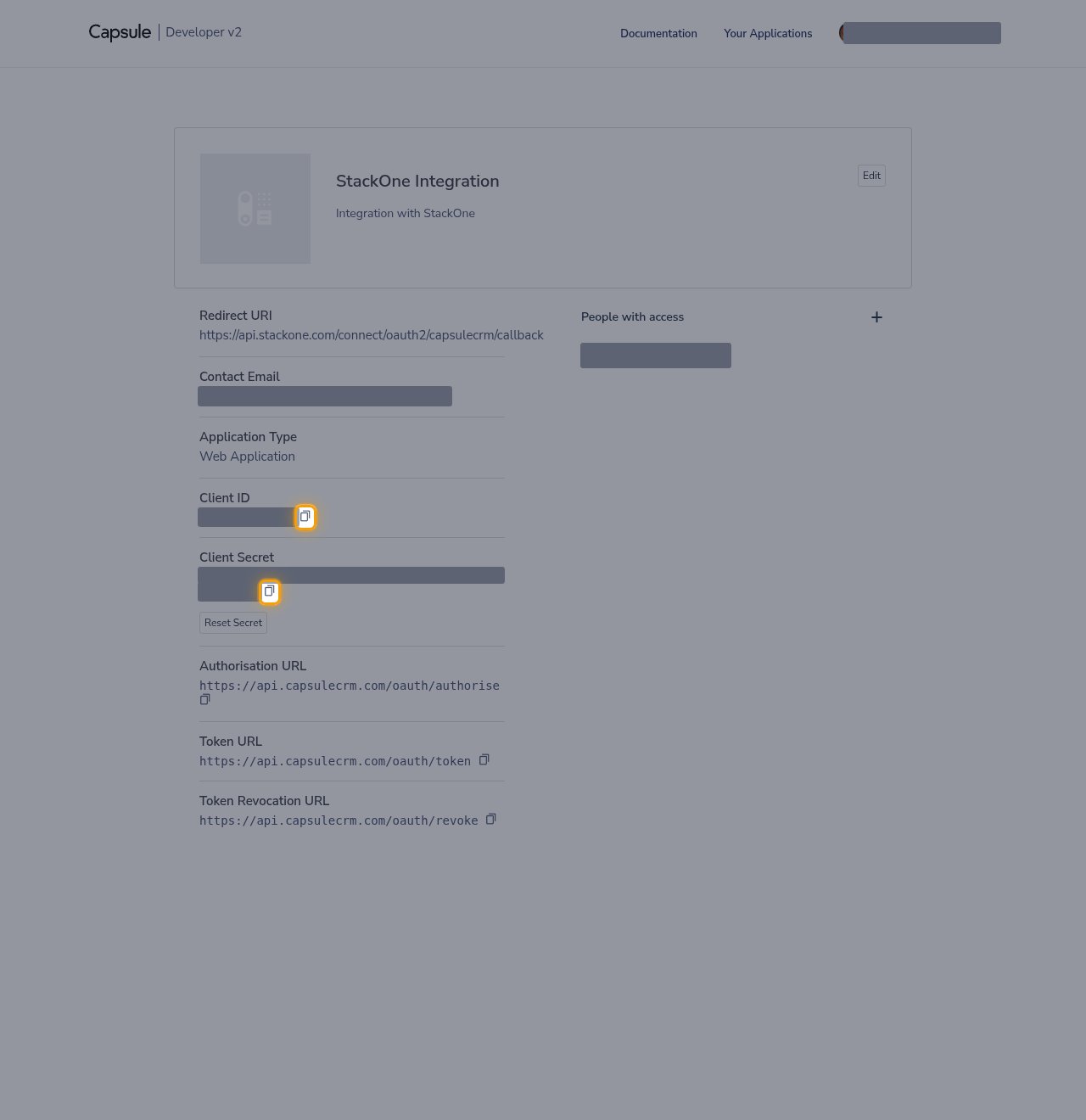
The application page with the Client ID and Client Secret values hidden and their copy buttons highlighted

Choosing OAuth scopes

The Scopes field in the StackOne Connector profile controls the permissions StackOne requests when a user authorizes the connection. Capsule has no scope settings on the application itself — the scopes are requested at authorization time.

1

Select the scopes to request

Enables actions: Add Party To Opportunity, Add Party To Project, Archive Board, Archive Pipeline, Create Board, Create Entry, Create Milestone, Create Opportunity, Create Opportunity Custom Field, Create Opportunity Tag, Create Party, Create Party Custom Field, Create Party Tag, Create Pipeline, Create Project, Create Project Custom Field, Create Project Tag, Create Stage, Create Task, Create Task Category, Create Track Definition, Delete Entry, Delete Milestone, Delete Opportunity, Delete Opportunity Custom Field, Delete Opportunity Tag, Delete Party, Delete Party Custom Field, Delete Party Tag, Delete Project, Delete Project Custom Field, Delete Project Tag, Delete Stage, Delete Task, Delete Task Category, Delete Track Definition, Duplicate Pipeline, Filter Opportunities, Filter Parties, Filter Projects, Get Attachment, Get Board, Get Current User, Get Entry, Get Milestone, Get Multiple Opportunities, Get Multiple Parties, Get Multiple Pipelines, Get Multiple Projects, Get Opportunity, Get Opportunity Custom Field, Get Opportunity Tag, Get Party, Get Party Custom Field, Get Party Tag, Get Pipeline, Get Project, Get Project Custom Field, Get Project Tag, Get Site, Get Stage, Get Task, Get Task Category, Get Team, Get Track Definition, Get Unified Credentials, Get Unified Group, Get Unified Organization, Get Unified User, Get User, List Activity Types, List Board Stages, List Boards, List Deleted Opportunities, List Deleted Parties, List Deleted Projects, List Entries, List Lost Reasons, List Milestones, List Opportunities, List Opportunity Custom Fields, List Opportunity Entries, List Opportunity Parties, List Opportunity Projects, List Opportunity Tags, List Parties, List Party Custom Fields, List Party Employees, List Party Entries, List Party Opportunities, List Party Projects, List Party Tags, List Pipeline Milestones, List Pipelines, List Project Custom Fields, List Project Entries, List Project Parties, List Project Tags, List Projects, List Stages, List Task Categories, List Tasks, List Teams, List Track Definitions, List Unified Groups, List Unified Organizations, List Unified Users, List Users, Remove Party From Opportunity, Remove Party From Project, Restore Board, Restore Pipeline, Search Opportunities, Search Parties, Search Projects, Update Board, Update Entry, Update Milestone, Update Opportunity, Update Opportunity Custom Field, Update Opportunity Tag, Update Party, Update Party Custom Field, Update Party Tag, Update Pipeline, Update Project, Update Project Custom Field, Update Project Tag, Update Stage, Update Task, Update Task Category, Update Track Definition, Update User, Upload Attachment

Leave Scopes empty to use the default of read write, or enter the scopes this integration needs as a space-separated list. write and user_preference each include read.

Creating the StackOne Connector Profile

To create the Connector Profile in StackOne for Capsule CRM:
1

Navigate to Connector Profiles

Login to StackOne and navigate to Connector Profiles
2

Create New Connector Profile

  • Click + Connector Profile
  • Search for and select Capsule CRM
  • Select Type as OAuth 2.0
  • Fill out the fields using details retrieved from your provider:
    • Client ID
    • Client Secret
    • Scopes (Optional)
  • (Optional) Select Actions to be enabled for this Connector Profile
  • Click Create profile
Congratulations! The new Connector Profile will now show up in your project ready to be used. You can now continue to Link Accounts for Capsule CRM.