> ## Documentation Index
> Fetch the complete documentation index at: https://docs.stackone.com/llms.txt
> Use this file to discover all available pages before exploring further.
# Directory Sync
> Automatically provision and deprovision members from your identity provider with SCIM.
Directory Sync provisions and deprovisions your StackOne members automatically from your identity provider (IdP) using SCIM. Create a user in your IdP and they become a member of your StackOne organization; deactivate them and StackOne suspends their access.
Directory Sync is part of your organization's SSO connection, not a connection of its own. You enable it on an SSO connection that already exists, so [set up SSO](/identity/sso/overview) first.
## How Directory Sync works
Directory Sync links your IdP to that SSO connection and keeps its membership aligned with your directory.
Directory Sync syncs users, not groups. Syncing groups or teams over SCIM is not supported yet.
An organization has a single Directory Sync. If you run more than one SSO connection, it binds to the **oldest** one and appears on every connection's **Provisioning** tab. Link and manage it there, and point one IdP at the SCIM base URL. StackOne doesn't support more than one SCIM source per organization.
### Provisioning
When you assign a user to the StackOne application in your IdP, StackOne:
* Adds them to your organization at the **Viewer** role, or **Admin** when your identity provider sends a `roles` value of `admin`. See [organization role from your identity provider](/identity/sso/jit-provisioning#organization-role-from-your-identity-provider) for the mapping.
* Grants them the connection's **provisioned access**: the projects you selected, each at the role you set for it (**Viewer**, **Member**, or **Admin**).
* Marks their email as verified only when your organization has DNS-verified that email's domain, so SSO can recognize and link the same person the first time they sign in.
The organization role is set the first time a user is provisioned. Changing the `roles` value in your identity provider later doesn't change an existing member's role. Adjust an existing member's role from the dashboard instead.
### Deprovisioning
When you deactivate or remove a user in your IdP, StackOne suspends their access to that organization and signs them out. The suspension is an org-scoped ban, so the user keeps any access they have in other organizations. Reactivating the user in your IdP lifts the suspension, unless an admin applied the ban manually from the dashboard.
Only members this connection provisioned are affected. A member who joined by invitation, or who was provisioned by a different connection, is left untouched. Directory Sync also won't deactivate the last active admin of an organization, so a sync can't lock everyone out, to offboard your last admin, promote or provision another org admin first.
Two deactivations intentionally fail on StackOne's side and appear as errors in your IdP's provisioning log. Both are expected and safe to ignore:
* Deactivating the **last active admin** is refused. Your IdP surfaces a failed provisioning action for that user and retries it on each sync.
* Deactivating a member this connection didn't provision, someone who joined by invitation, or was synced by a different connection, returns "user not found".
## Prerequisites
* A verified SSO connection for your organization, since Directory Sync is enabled on it. See [SSO overview](/identity/sso/overview).
* The **Org Admin** role.
The projects and roles synced members receive are the connection's shared **provisioned access**, set on the **Provisioned access** card of the **Provisioning** tab. [JIT provisioning](/identity/sso/jit-provisioning) applies the same set, so configuring it once covers both.
Verify your SSO domain **before** you assign users in your IdP. StackOne doesn't block linking SCIM on an unverified connection, but until the domain is verified, provisioned users are created with their email **unverified**, so a later SSO sign-in isn't recognized as the same person, and you can end up with duplicate or orphaned accounts. Confirm **Verification Status: Verified** on the connection's **General** tab first.
## Enable Directory Sync
Link SCIM from the SSO connection's **Provisioning** tab, then finish the setup in your IdP.
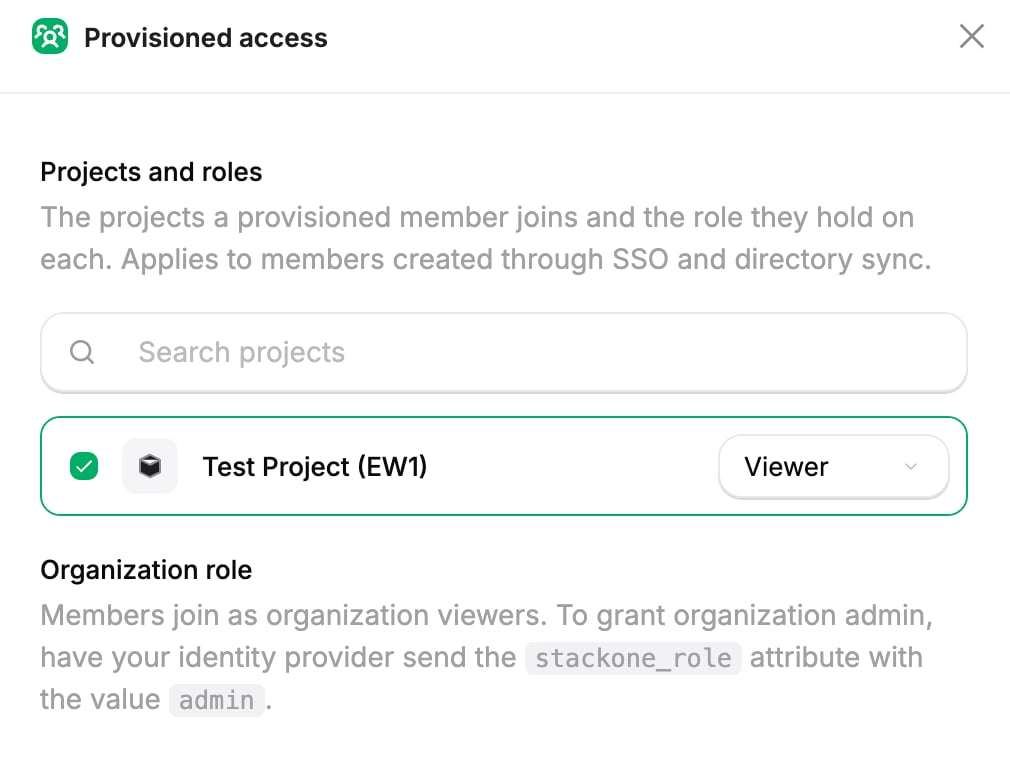
In the StackOne dashboard, go to **Organization > Security > SSO** and open your verified SSO connection. Select the **Provisioning** tab, then, on the **Provisioned access** card, select **Manage access**.
Pick the projects synced members should join and choose a role for each one (**Viewer**, **Member**, or **Admin**), then select **Save changes**. Pick the least-privilege role that fits each project. Every provisioned user is still added to your organization at the **Viewer** role (or **Admin** from your identity provider), regardless of the project roles you choose. This access is shared with [JIT provisioning](/identity/sso/jit-provisioning).
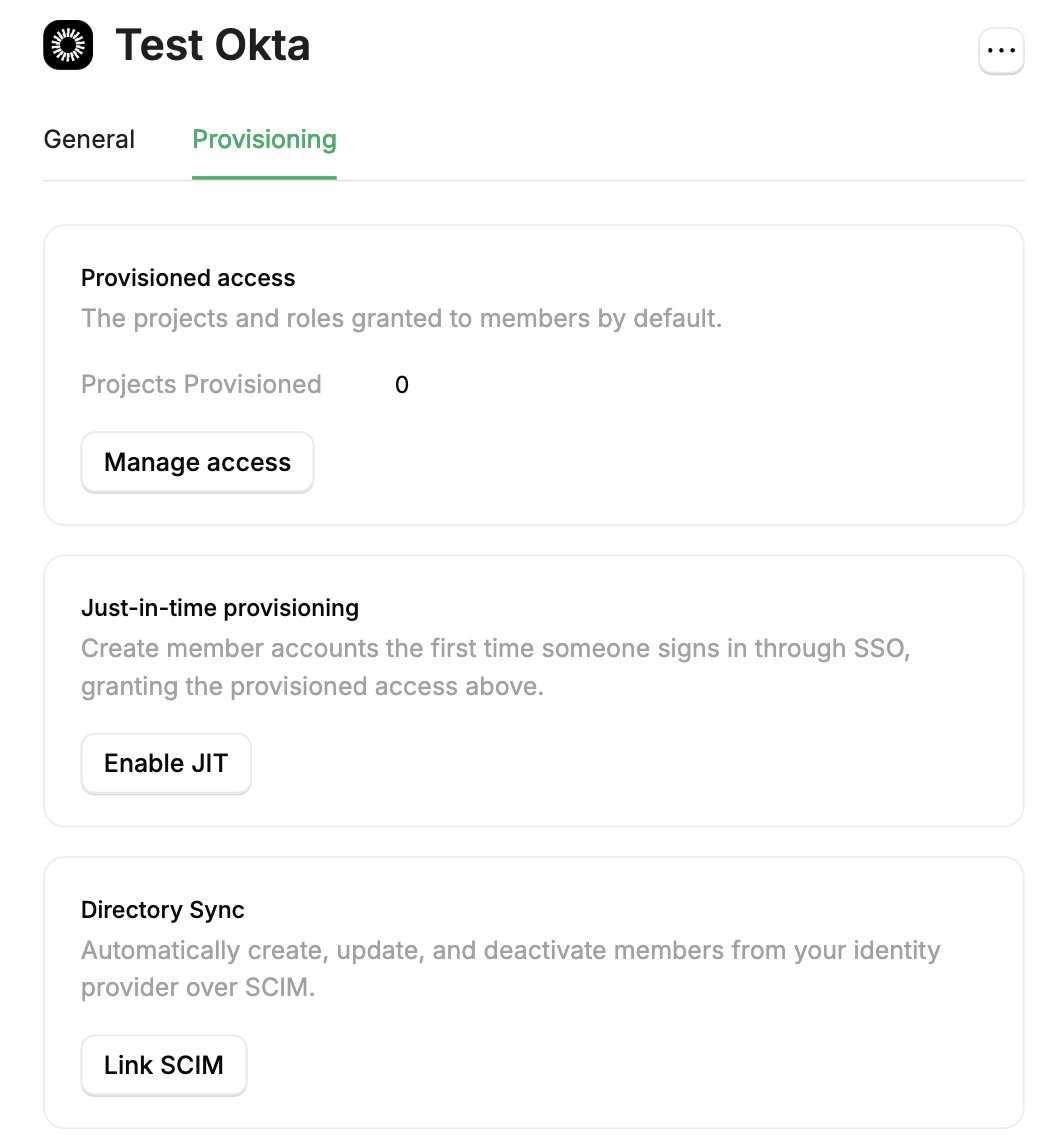
 On the **Directory Sync** card, select **Link SCIM**. StackOne creates the connection and opens the **Directory Sync** panel with your SCIM credentials. If you haven't set any provisioned access yet, linking walks you through picking it first.
 In the **SCIM Details** section, copy the **SCIM base URL** and the **Provisioning token**. You paste both into your IdP.
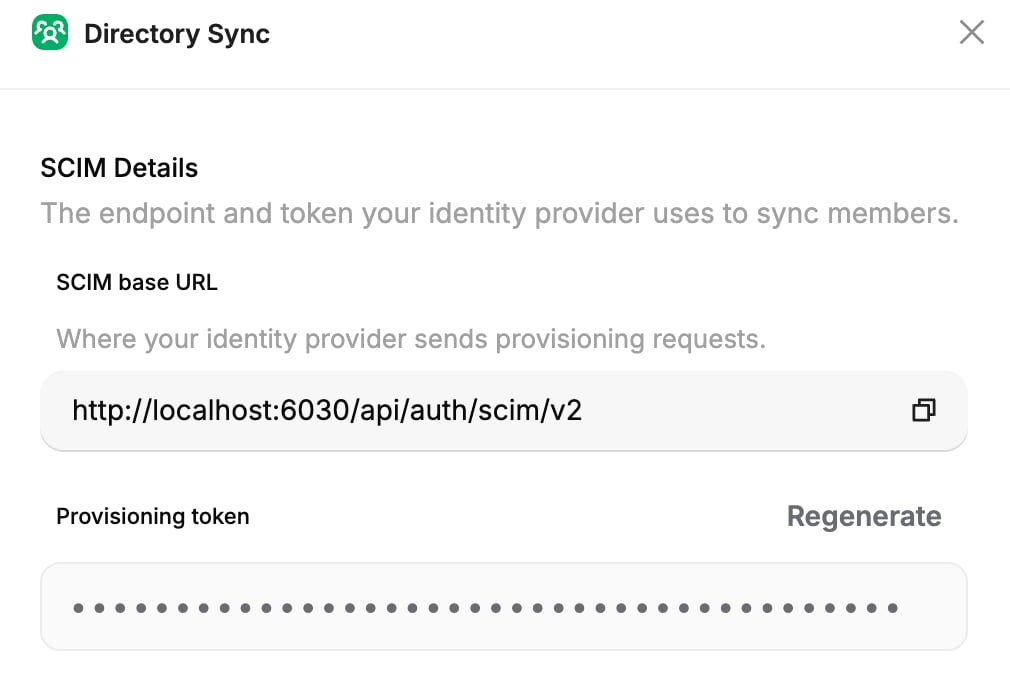 Copy the **SCIM base URL** and **Provisioning token** now. The token is shown only once: closing the panel hides it for good, and you'd have to regenerate it. Store it somewhere safe.
To rotate the token later, select **Regenerate**, then **Confirm rotate**. Rotating invalidates the previous token immediately and breaks any IdP still using the old one, so update your IdP with the new value right away.
In your IdP, enable provisioning for the StackOne application, paste in the SCIM base URL and token, then assign the users who should sync. Follow the guide for your IdP in [Next steps](#next-steps).
## Manage or remove Directory Sync
Manage the connection from the **Directory Sync** card on the SSO connection's **Provisioning** tab.
* **Edit SCIM** reopens the Directory Sync panel to rotate the token. To change the projects synced members join or their roles, use **Manage access** on the **Provisioned access** card instead.
* **Unlink** stops all future provisioning and revokes the SCIM token. Members synced so far keep their access. You can link again later, but StackOne mints a **new** token, the SCIM base URL doesn't change, so you only need to paste the new token back into your IdP.
Deleting the SSO connection also removes Directory Sync and revokes its token, because Directory Sync rides on that connection. If you delete and recreate the connection, for example, to replace a certificate, you'll need to link SCIM again and paste the new token into your IdP. That connection's delete confirmation doesn't mention Directory Sync, so it's easy to wipe your SCIM setup by accident.
## Next steps
Enable SCIM provisioning on an Okta SSO connection.
Enable SCIM provisioning on a Microsoft Entra SSO connection.
Set up the SSO connection that Directory Sync builds on.
Grant many members the same project or account access at once.
Copy the **SCIM base URL** and **Provisioning token** now. The token is shown only once: closing the panel hides it for good, and you'd have to regenerate it. Store it somewhere safe.
To rotate the token later, select **Regenerate**, then **Confirm rotate**. Rotating invalidates the previous token immediately and breaks any IdP still using the old one, so update your IdP with the new value right away.
In your IdP, enable provisioning for the StackOne application, paste in the SCIM base URL and token, then assign the users who should sync. Follow the guide for your IdP in [Next steps](#next-steps).
## Manage or remove Directory Sync
Manage the connection from the **Directory Sync** card on the SSO connection's **Provisioning** tab.
* **Edit SCIM** reopens the Directory Sync panel to rotate the token. To change the projects synced members join or their roles, use **Manage access** on the **Provisioned access** card instead.
* **Unlink** stops all future provisioning and revokes the SCIM token. Members synced so far keep their access. You can link again later, but StackOne mints a **new** token, the SCIM base URL doesn't change, so you only need to paste the new token back into your IdP.
Deleting the SSO connection also removes Directory Sync and revokes its token, because Directory Sync rides on that connection. If you delete and recreate the connection, for example, to replace a certificate, you'll need to link SCIM again and paste the new token into your IdP. That connection's delete confirmation doesn't mention Directory Sync, so it's easy to wipe your SCIM setup by accident.
## Next steps
Enable SCIM provisioning on an Okta SSO connection.
Enable SCIM provisioning on a Microsoft Entra SSO connection.
Set up the SSO connection that Directory Sync builds on.
Grant many members the same project or account access at once.