> ## Documentation Index
> Fetch the complete documentation index at: https://docs.stackone.com/llms.txt
> Use this file to discover all available pages before exploring further.

# MongoDB Atlas Webhook Setup Guide

> Configure MongoDB Atlas to deliver events to StackOne.

## Prerequisites

The connector should already be set up, with a Connector Profile and a Linked Account. See [Getting Started](/connectors/mongodb#getting-started) on the MongoDB Atlas connector page.

<section data-guide-section data-guide-scopes="">
  <h2>Copy your Native Webhook URL</h2>

  <p>Before configuring Atlas, copy the <strong>Native Webhook URL</strong> from this connection in StackOne Hub. This is the address Atlas posts alert events to — you will paste it into the Webhook integration in the next step, and every alert you route to it will be delivered here.</p>
</section>

<section data-guide-section data-guide-scopes="">
  <h2>Create the Webhook integration in Atlas</h2>

  <p>Register the Native Webhook URL as a project Webhook integration so Atlas can deliver alert notifications to it.</p>

  <Steps>
    <Step title="Open Integrations and configure Webhook Settings">
      <div data-guide-step data-guide-scopes="" data-guide-display-scopes-list="">
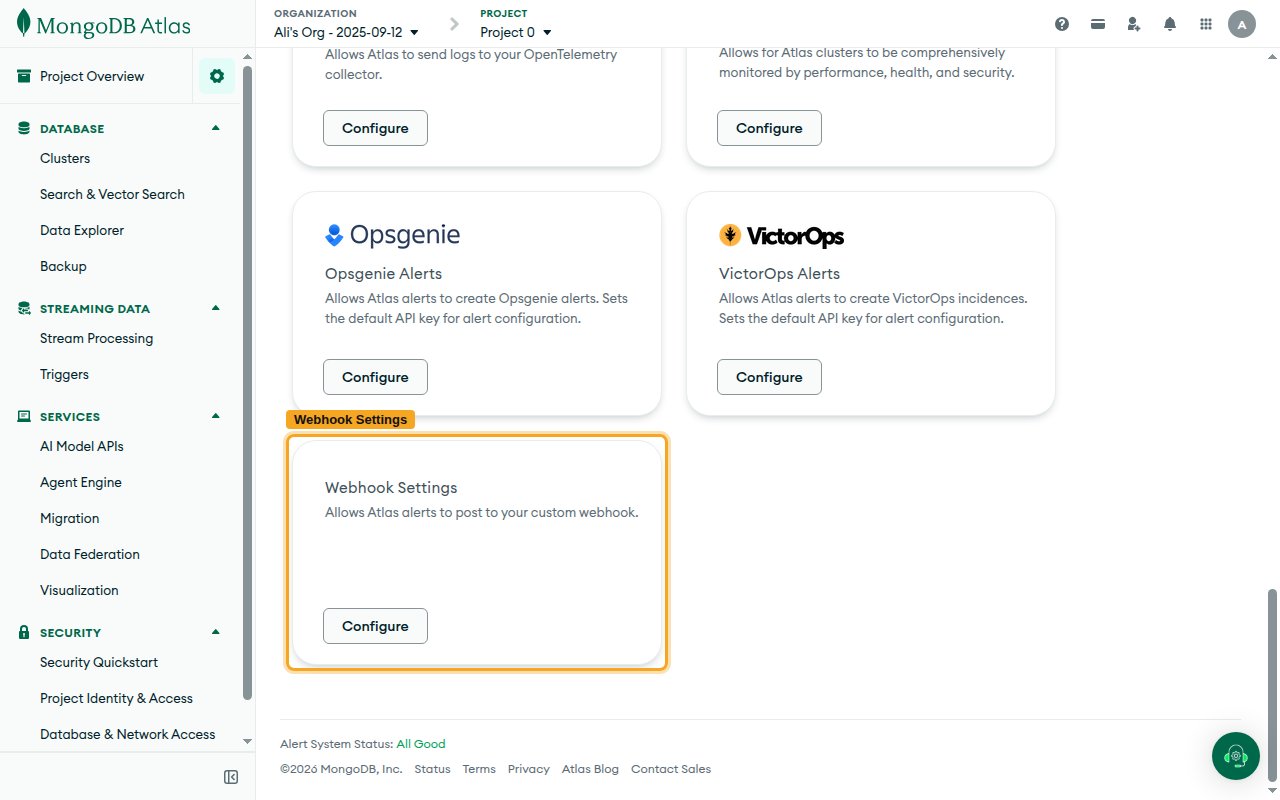
        <p>Sign in to <a href="https://cloud.mongodb.com/" target="_blank" rel="noopener noreferrer">MongoDB Atlas</a>, select your project, open <strong>Project Settings</strong>, and select the <strong>Integrations</strong> tab. Find the <strong>Webhook Settings</strong> card ("Allows Atlas alerts to post to your custom webhook") and click its <strong>Configure</strong> button.</p>

        <img src="https://mintcdn.com/stackone-60/5IlaXCCFBwGKgDpF/connectors/mongodb/images/events-integrations-webhook-card.png?fit=max&auto=format&n=5IlaXCCFBwGKgDpF&q=85&s=e5875be22c39cfa9609c40dfcc03048c" alt="The Project Settings Integrations tab with the Webhook Settings card and its Configure button highlighted." width="1280" height="800" data-path="connectors/mongodb/images/events-integrations-webhook-card.png" />
      </div>
    </Step>

    <Step title="Enter your Webhook URL and save">
      <div data-guide-step data-guide-scopes="" data-guide-display-scopes-list="">
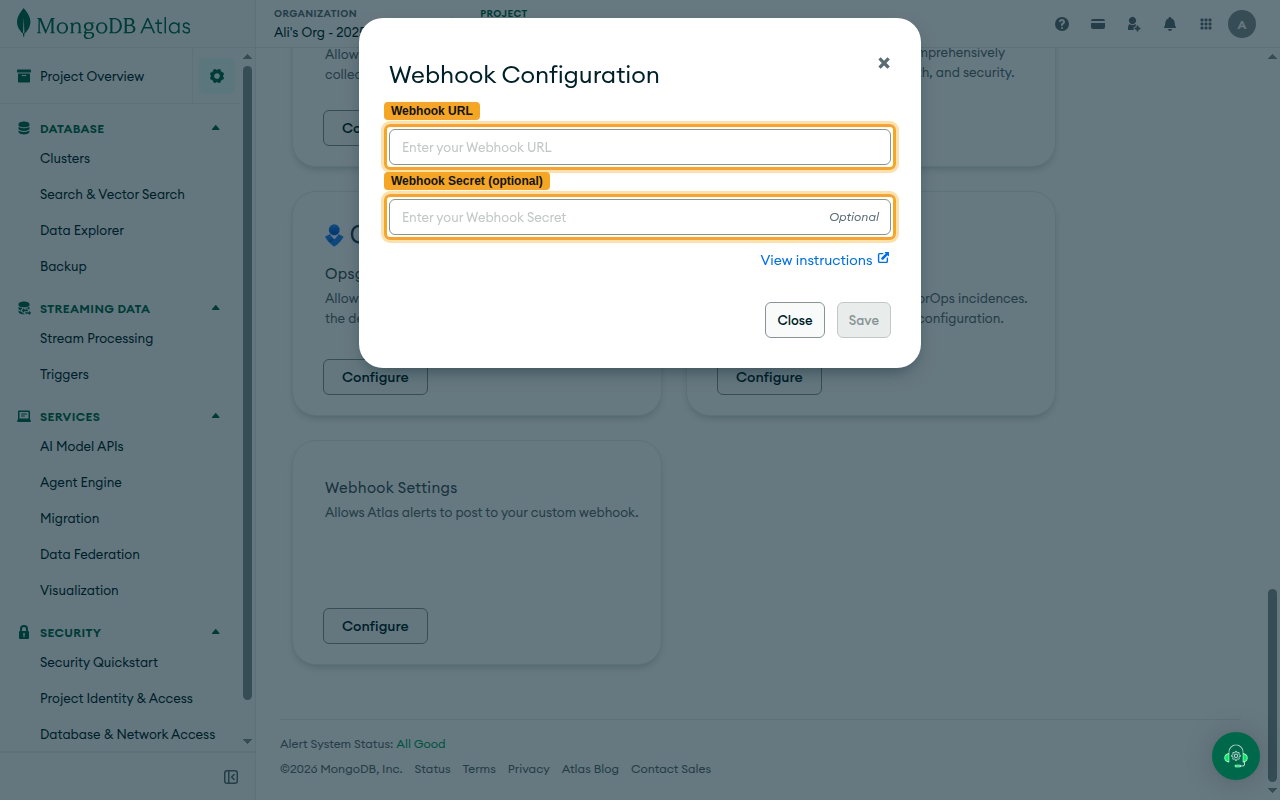
        <p>In the <strong>Webhook Configuration</strong> dialog, paste your Native Webhook URL into the <strong>Webhook URL</strong> field. Optionally enter a <strong>Webhook Secret</strong> — Atlas uses it to sign each delivery (the field is marked <strong>Optional</strong>). Click <strong>Save</strong>.</p>

        <img src="https://mintcdn.com/stackone-60/5IlaXCCFBwGKgDpF/connectors/mongodb/images/events-webhook-configuration.png?fit=max&auto=format&n=5IlaXCCFBwGKgDpF&q=85&s=dc566b0f940d74544881355b4a8b600a" alt="The Webhook Configuration dialog with the Webhook URL and Webhook Secret fields highlighted." width="1280" height="800" data-path="connectors/mongodb/images/events-webhook-configuration.png" />
      </div>
    </Step>
  </Steps>
</section>

<section data-guide-section data-guide-scopes="">
  <h2>Add alerts that notify the webhook</h2>

  <p>The Webhook integration only receives alerts you route to it. Create or edit alert configurations so the events you care about are delivered to the webhook.</p>

  <Steps>
    <Step title="Add a new alert">
      <div data-guide-step data-guide-scopes="" data-guide-display-scopes-list="">
        <p>Open <strong>Alerts</strong> for the project and click <strong>Add New Alert</strong>. In the <strong>Create a New Alert</strong> dialog, choose the <strong>Category</strong> and <strong>Condition/Metric</strong> to alert on (for example <strong>Host is down</strong>).</p>
      </div>
    </Step>

    <Step title="Add a Webhook notifier">
      <div data-guide-step data-guide-scopes="" data-guide-display-scopes-list="">
        <p>Under <strong>Add Notification Method</strong>, click <strong>Add Notifier</strong> and choose <strong>Webhook</strong> as the notification type, then click <strong>Save</strong>. Repeat for each condition you want delivered — only alerts with a Webhook notifier are sent. See the <a href="https://www.mongodb.com/docs/atlas/tutorial/webhook-integration/" target="_blank" rel="noopener noreferrer">Atlas webhook integration guide</a> for details.</p>
      </div>
    </Step>
  </Steps>
</section>

<section data-guide-section data-guide-scopes="">
  <h2>Available webhook events</h2>

  <p>Atlas delivers many alert types to a single webhook; StackOne routes each by its `eventTypeName`. Only alert types you enable with a Webhook notification are delivered.</p>

  <Steps>
    <Step title="Host and replica-set events">
      <div data-guide-step data-guide-scopes="" data-guide-display-scopes-list="">
        <p>Availability and replication alerts for hosts and replica sets.</p>

        <ul>
          <li><strong>Host Down</strong> (`HOST_DOWN`) — Fired when Atlas cannot reach a host.</li>
          <li><strong>Host Recovering</strong> (`HOST_RECOVERING`) — Fired when a host is in a recovering state.</li>
          <li><strong>No Primary</strong> (`NO_PRIMARY`) — Fired when a replica set has no primary.</li>
          <li><strong>Replication Oplog Window Running Out</strong> (`REPLICATION_OPLOG_WINDOW_RUNNING_OUT`) — Fired when the oplog window falls below the configured threshold.</li>
        </ul>
      </div>
    </Step>

    <Step title="Cluster and metric events">
      <div data-guide-step data-guide-scopes="" data-guide-display-scopes-list="">
        <p>Cluster health and metric-threshold alerts.</p>

        <ul>
          <li><strong>Outside Metric Threshold</strong> (`OUTSIDE_METRIC_THRESHOLD`) — Fired when a monitored metric (for example disk or connections) crosses its configured threshold.</li>
          <li><strong>Cluster Mongos Is Missing</strong> (`CLUSTER_MONGOS_IS_MISSING`) — Fired when a sharded cluster has no reachable mongos.</li>
        </ul>
      </div>
    </Step>

    <Step title="Billing and security events">
      <div data-guide-step data-guide-scopes="" data-guide-display-scopes-list="">
        <p>Organization billing and user-security alerts.</p>

        <ul>
          <li><strong>Credit Card About To Expire</strong> (`CREDIT_CARD_ABOUT_TO_EXPIRE`) — Fired when the billing credit card is near expiry.</li>
          <li><strong>Users Without Multi-Factor Auth</strong> (`USERS_WITHOUT_MULTI_FACTOR_AUTH`) — Fired when users lack multi-factor authentication.</li>
        </ul>
      </div>
    </Step>
  </Steps>
</section>

<section data-guide-section data-guide-scopes="">
  <h2>Delivery format</h2>

  <p>Details of how Atlas delivers alert events to StackOne.</p>

  <Steps>
    <Step title="Alert payload and lifecycle">
      <div data-guide-step data-guide-scopes="" data-guide-display-scopes-list="">
        <p>Each delivery is a JSON object matching the Atlas alert resource — top-level `id`, `groupId`, `alertConfigId`, `eventTypeName`, `status` (`OPEN`/`CLOSED`), `created`, and `humanReadable`, plus any cluster, host, or metric context. The lifecycle state (`alert.open`, `alert.close`, …) also arrives in the `X-MMS-Event` header.</p>
      </div>
    </Step>

    <Step title="Signature">
      <div data-guide-step data-guide-scopes="" data-guide-display-scopes-list="">
        <p>Atlas signs every delivery with an `X-MMS-Signature` header — a Base64-encoded HMAC-SHA1 digest of the request body computed with the integration secret. StackOne does <strong>not</strong> verify or enforce this signature; the unique token in the <strong>Native Webhook URL</strong> is the authentication boundary, so keep that URL secret. If you need to validate the HMAC signature, do so downstream in your own event consumer.</p>
      </div>
    </Step>
  </Steps>
</section>

## Verify

Your Connector should now be able to receive and process events. Try triggering an event and you should see an Event appear in the Connector logs.


This documentation is built and hosted on [Mintlify](https://mintlify.com), a developer documentation platform.