> ## Documentation Index
> Fetch the complete documentation index at: https://docs.stackone.com/llms.txt
> Use this file to discover all available pages before exploring further.

# JumpCloud Webhook Setup Guide

> Configure JumpCloud to deliver events to StackOne.

## Prerequisites

The connector should already be set up, with a Connector Profile and a Linked Account. See [Getting Started](/connectors/jumpcloud#getting-started) on the JumpCloud connector page.

<section data-guide-section data-guide-scopes="">
  <h2>Copy your Native Webhook URL</h2>

  <p>Before configuring JumpCloud, copy the <strong>Native Webhook URL</strong> from this connection in StackOne Hub. This is the address JumpCloud will POST events to. You will paste it into the <strong>URL</strong> field when you create the webhook channel in the next steps.</p>
</section>

<section data-guide-section data-guide-scopes="">
  <h2>Create a webhook channel in JumpCloud</h2>

  <p>Sign in to JumpCloud and add a webhook channel that points at StackOne.</p>

  <Steps>
    <Step title="Sign in to JumpCloud">
      <div data-guide-step data-guide-scopes="" data-guide-display-scopes-list="">
        <p>Sign in to the <a href="https://console.jumpcloud.com" target="_blank" rel="noopener noreferrer">JumpCloud Admin Portal</a> with an administrator account.</p>
      </div>
    </Step>

    <Step title="Open Settings and Notification Channels">
      <div data-guide-step data-guide-scopes="" data-guide-display-scopes-list="">
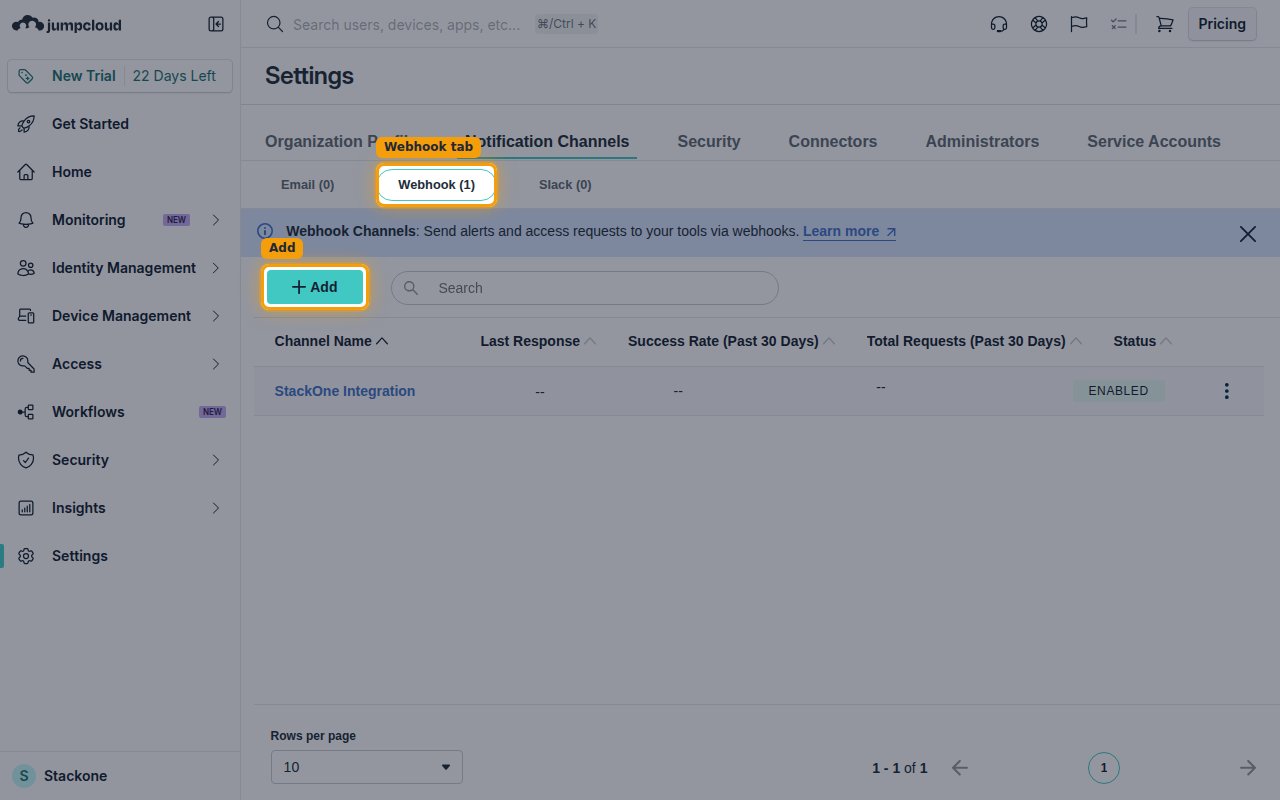
        <p>In the left navigation, open <strong>Settings</strong>, select the <strong>Notification Channels</strong> tab, then select the <strong>Webhook</strong> tab and click <strong>Add</strong>.</p>

        <img src="https://mintcdn.com/stackone-60/-m_Wkya09ptn4WD9/connectors/jumpcloud/images/events-notification-channels.png?fit=max&auto=format&n=-m_Wkya09ptn4WD9&q=85&s=139b69ebb4904e17837ddb993434b3ea" alt="The Notification Channels page with the Webhook tab and the Add button." width="1280" height="800" data-path="connectors/jumpcloud/images/events-notification-channels.png" />
      </div>
    </Step>

    <Step title="Enter the name and Native Webhook URL">
      <div data-guide-step data-guide-scopes="" data-guide-display-scopes-list="">
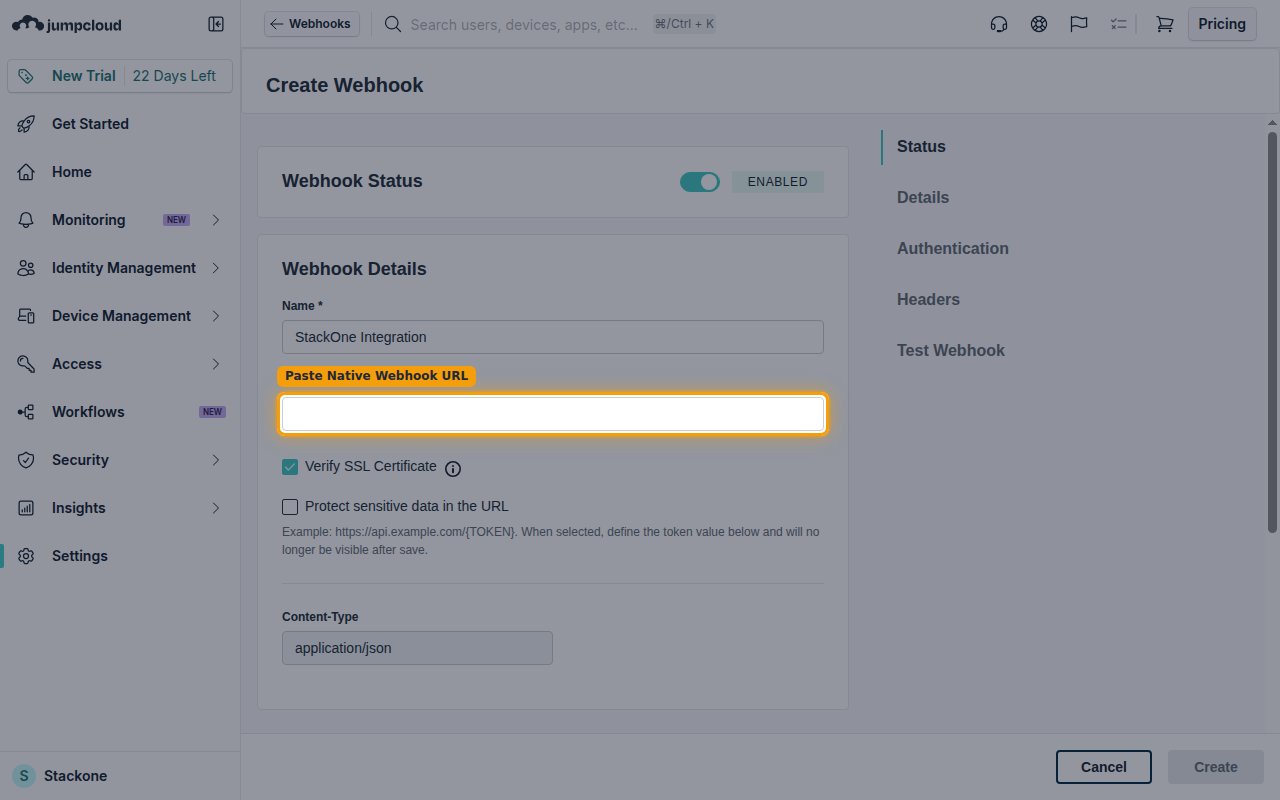
        <p>On the <strong>Create Webhook</strong> screen, enter a <strong>Name</strong> for the channel (for example, StackOne Integration), and paste the <strong>Native Webhook URL</strong> you copied from StackOne Hub into the <strong>URL</strong> field. Leave <strong>Content-Type</strong> set to <strong>application/json</strong>, keep <strong>Verify SSL Certificate</strong> enabled, and click <strong>Create</strong>.</p>

        <img src="https://mintcdn.com/stackone-60/-m_Wkya09ptn4WD9/connectors/jumpcloud/images/events-create-webhook.png?fit=max&auto=format&n=-m_Wkya09ptn4WD9&q=85&s=e7a039615699e963d858835f2f8a5dc3" alt="The Create Webhook screen with the Name field, the URL field, and the Content-Type set to application/json." width="1280" height="800" data-path="connectors/jumpcloud/images/events-create-webhook.png" />
      </div>
    </Step>
  </Steps>
</section>

<section data-guide-section data-guide-scopes="">
  <h2>Send events to the channel with an Insights Rule</h2>

  <p>A webhook channel only receives the events that an Insights Rule sends to it.</p>

  <Steps>
    <Step title="Create an Insights Rule">
      <div data-guide-step data-guide-scopes="" data-guide-display-scopes-list="">
        <p>Create an <a href="https://jumpcloud.com/support/create-an-insights-rule" target="_blank" rel="noopener noreferrer">Insights Rule</a> that matches the directory events you want to receive (for example user lockouts, user creation, or authentications), and select the webhook channel you just created as the rule's notification channel. JumpCloud will then POST an alert to the Native Webhook URL each time the rule matches.</p>
      </div>
    </Step>
  </Steps>
</section>

<section data-guide-section data-guide-scopes="">
  <h2>Available webhook events</h2>

  <p>JumpCloud delivers webhooks through Directory Insights Rules rather than a fixed set of named events, so the connector exposes a single generic event. Which directory events it fires on is determined entirely by the Insights Rules you attach to the channel.</p>

  <Steps>
    <Step title="Directory Insights events">
      <div data-guide-step data-guide-scopes="" data-guide-display-scopes-list="">
        <p>Fired by any Insights Rule attached to the webhook channel.</p>

        <ul>
          <li><strong>Directory Insights Alert</strong> (`insights_alert`) — Fired when an Insights Rule matches a directory event (for example a user lockout, user creation, or authentication). The underlying event is identified by the payload's `type` field.</li>
        </ul>
      </div>
    </Step>
  </Steps>
</section>

<section data-guide-section data-guide-scopes="">
  <h2>Delivery format</h2>

  <p>Details of how JumpCloud delivers events to StackOne.</p>

  <Steps>
    <Step title="Review the payload format">
      <div data-guide-step data-guide-scopes="" data-guide-display-scopes-list="">
        <p>JumpCloud sends a single JSON object per alert (not a batched array). The payload's <strong>type</strong> field names the underlying event (for example `user_lockout`), a <strong>tags</strong> array carries the event's key/value details, and <strong>organization\_object\_id</strong> identifies your JumpCloud organization. JumpCloud does not sign webhook deliveries, so the unguessable Native Webhook URL is what keeps the endpoint secure.</p>
      </div>
    </Step>
  </Steps>
</section>

## Verify

Your Connector should now be able to receive and process events. Try triggering an event and you should see an Event appear in the Connector logs.


This documentation is built and hosted on [Mintlify](https://mintlify.com), a developer documentation platform.