> ## Documentation Index
> Fetch the complete documentation index at: https://docs.stackone.com/llms.txt
> Use this file to discover all available pages before exploring further.

# Connect Egnyte with OAuth 2.0 (Public Application) – StackOne Hub

> Link a Egnyte account in the StackOne Hub using OAuth 2.0 (Public Application). End-user guide to authorize the integration and start using Egnyte actions.

<section data-guide-section data-guide-scopes="">
  <h2>Find your Egnyte Domain</h2>

  <p>Every Egnyte account is scoped to a unique subdomain of `egnyte.com`. StackOne needs that subdomain to build the correct OAuth and API endpoints for your tenant.</p>

  <Steps>
    <Step title="Sign in to your Egnyte account">
      <div data-guide-step data-guide-scopes="" data-guide-display-scopes-list="">
        <p>Open your browser and go to your Egnyte sign-in URL — the address you normally use to reach Egnyte, in the form `https://acme.egnyte.com` (replace `acme` with your organisation's subdomain). If you don't know your domain, ask an Egnyte Domain Admin at your organisation, or check a recent Egnyte email — links point at your workspace URL.</p>
      </div>
    </Step>

    <Step title="Locate your Egnyte subdomain">
      <div data-guide-step data-guide-scopes="" data-guide-display-scopes-list="">
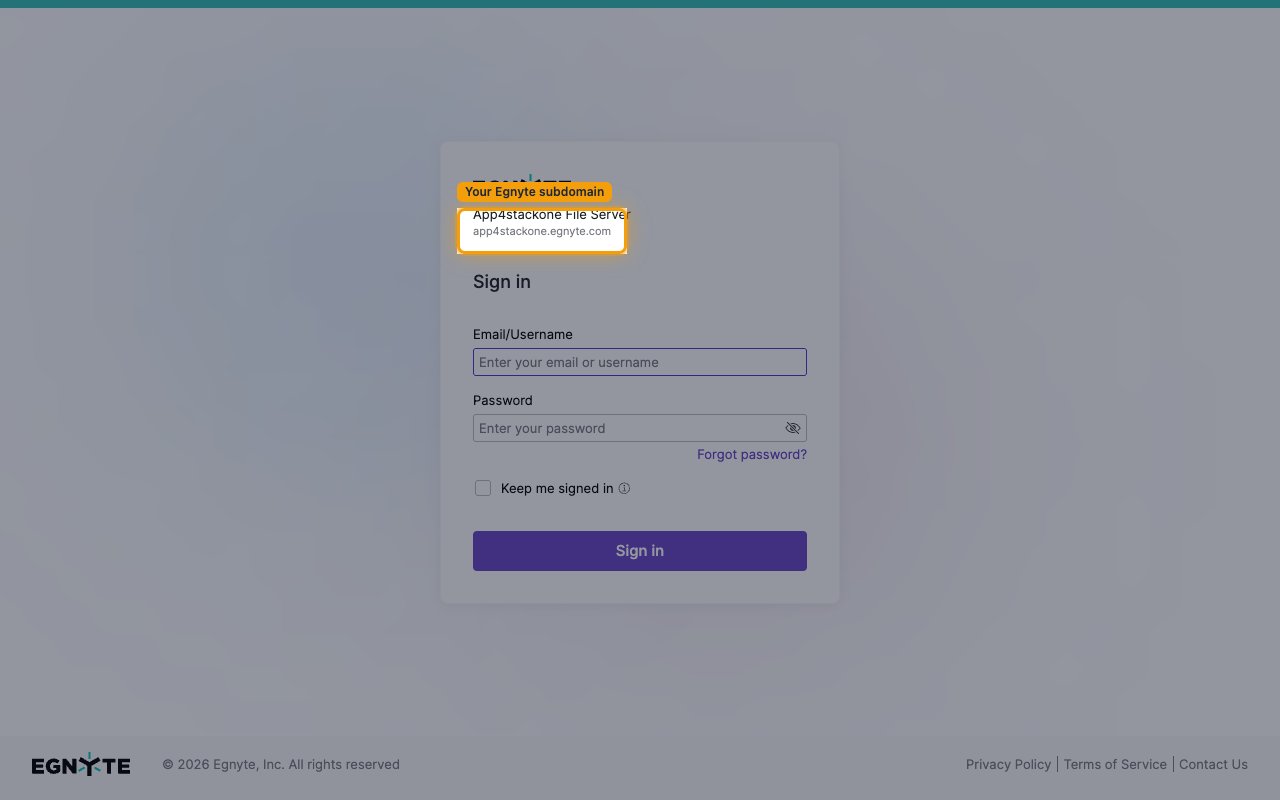
        <p>On the Egnyte <strong>Sign in</strong> page (and in the browser address bar) you will see your workspace URL. The part before `.egnyte.com` is your Egnyte Domain. For example, if the sign-in page shows `app4stackone.egnyte.com`, your Egnyte Domain is `app4stackone`.</p>

        <ul>
          <li>Enter only the subdomain part — omit any scheme prefix, the `.egnyte.com` suffix, and any trailing path.</li>
          <li>The domain contains only letters, numbers, and hyphens — no spaces or special characters.</li>
          <li>Trial domains are not eligible for the Egnyte Public API.</li>
        </ul>

        <img src="https://mintcdn.com/stackone-60/z1f68Vshj_J7cwjE/connectors/egnyte/images/oauth2-config-find-domain.png?fit=max&auto=format&n=z1f68Vshj_J7cwjE&q=85&s=fa8a843ea63043f1bf50e338bbb9e459" alt="Egnyte tenant sign-in page showing the workspace name and the tenant subdomain" width="1280" height="800" data-path="connectors/egnyte/images/oauth2-config-find-domain.png" />
      </div>
    </Step>

    <Step title="Enter the domain in StackOne Hub">
      <div data-guide-step data-guide-scopes="" data-guide-display-scopes-list="">
        <p>Paste the subdomain you identified into the <strong>Egnyte Domain</strong> field in StackOne Hub, then continue with the OAuth connection flow.</p>

        <ul>
          <li><strong>Egnyte Domain</strong> — the customer's Egnyte subdomain (for example, `acme` for `https://acme.egnyte.com`).</li>
        </ul>
      </div>
    </Step>
  </Steps>
</section>

<div data-whitelabel-hide>
  <h2>Linking the Account from the Hub</h2>

  <Steps>
    <Step title="Navigate to the Hub">
      Use one of the three <a href="/guides/accounts-section#linking-accounts">Linking Account Methods</a> to access the Hub.
    </Step>

    <Step title="Fill out the fields">
      Fill out the following fields using details from your provider:

      <ul>
        <li><strong>Egnyte Domain</strong></li>
      </ul>
    </Step>

    <Step title="Connect">
      <ul>
        <li>Click <strong>Connect</strong></li>
        <li>If applicable, the provider will redirect you to a sign-in or authorization page. Complete the provider's authorization flow.</li>
        <li>Once authorization is successful, you will see a confirmation popup</li>
      </ul>
    </Step>
  </Steps>

  <p>If the account linking is successful, you will see the newly linked account in your <a href="/guides/accounts-section">Accounts</a> page.</p>
</div>